

| PATIENTS | PRACTITIONERS |
| If you have been authorised a test by your practitioner, or would like more information on how to conduct your functional test click HERE | If you already have a Research Nutrition account, please log in below. If you do not have an account and would like to sign up for one, you can do so online HERE |
Key Advantages
- Identify if IgE (allergy) reactivity is occurring to mould
- Connect immune responses to specific moulds, allowing for specific treatment
- Proves past history of mould exposure
- Assists allergic patients in identifying which compounds are causing IgE reactivity e.g. mould, foods, pollen, other chemicals
- The Mould IgE Allergy panel includes 12 mould allergens, with markers known to be involved in mould-related illnesses
SIGNIFICANCE OF MOULD IGE ALLERGY TESTING
Mould allergy is an abnormal immune reaction to mould spores or mould cell components. People can be exposed to mould spores or byproducts at work, home or outdoors.
Certain occupations have potential for high mould exposure: crop and dairy farming, greenhouse plant husbandry, logging, carpentry, millwork, furniture repair and commercial baking.
A high exposure in the home can occur in damp areas such as bathrooms, kitchens and basements.
In general, working or living in damp buildings with moisture higher than 50% humidity, increases the possibility of mould exposure.
Immune reactions to mould can be identified by the level of immunoglobulin E (IgE) antibodies to specific mould species.
The Great Plains Laboratory now offers an IgE blood test that measures patient antibodies to most common moulds. The IgE antibodies are detected in blood serum using an FDA-approved enzyme-linked immunosorbent assay (ELISA).
The most common moulds known to cause allergic conditions include Alternaria, Aspergillus, Cladosporium and Penicillium. Use of both tests allow a wider array of moulds to be detected.
ADVANTAGES OF IGE MOULD ALLERGY TEST
Identify IgE reactivity level to specific mould species.
Connect immune responses to specific moulds.
Suggest history of mould exposure.
Current higher reactivity or potential past lower reactivity.

Helpful for individuals with allergies, asthma and other respiratory conditions that may be due to histamine release and other inflammatory mediators resulting from IgE reactivity or other immune reactions.
Link IgE results with mould allergy symptoms, which include cough and postnasal drip, watery eyes, itchy eyes, nose, throat, runny or stuffy nose, or dry, scaly skin. In addition, possibly assist in identifying abnormal reactions to mould, including mould-induced asthma, allergic bronchopulmonary aspergillosis, allergic fungal sinusitis, hypersensitivity pneumonitis, and dampness and mould hypersensitivity syndrome (DMHS)
DIFFERENCE FROM MYCOTOX PROFILE AND WHY BOTH ARE BENEFICIAL
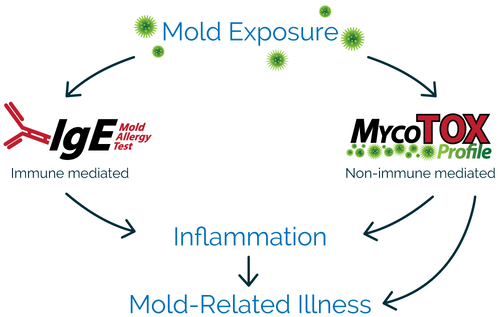
- IgE looks at immune response to mould exposure.
- MycoTOX Profile looks at mycotoxin levels excreted from the body.
- Mould allergies and mould mycotoxin toxicity are distinct responses related to mould illness.
- 70% of patients exposed to mould have positive skin tests to those moulds, indicating that testing for IgE antibody in blood will complement the mycotoxin test.
- IgE levels predict individual response, mild or severe, to the moulds in the environment.
- IgE levels may indicate reactivity to mould species whose mycotoxin products were not excreted at the time of the mycotoxin test or are not among the mycotoxins included in the MycoTOX Profile.
- The two tests provide a more comprehensive picture of individual mould exposure.
- Mycotoxins predict the effects of toxins on multiple bio-systems in the body.
MOULD AND ASSOCIATED ENVIRONMENT/MYCOTOXINS
Penicillium notatum (chrysogenum)
Found in food and damp buildings. Can cause respiratory conditions like pneumonia, localized granulomas, fungus balls, asthma and systemic infections like endophthalmitis. Species of this mould produce the mycotoxins gliotoxin, ochratoxin, sterigmatocystin, citrinin, and mycophenolic acid, which are measured in the MycoTOX Profile.
Cladosporium herbarum
Common outdoor mould found in 70% of homes tested in the US. Found in food stuffs, paint, windowsills, HVAC systems.
Aspergillus fumigatus
Ubiquitous, common in outdoor air, contaminates foodstuffs such as stored grains and crops, and decaying plant material (compost, peat, hay, soil, wood chips). A. fumigatus readily grows in indoor environments on dampened building materials (plasterboard, wood, chipboard, ceiling tiles, cardboard, and insulation material) usually producing a light to medium growth, grey to greyish-green. Species of Aspergillus produce the mycotoxins aflatoxin, ochratoxin, sterigmatocystin, gliotoxin, and citrinin. All are measured in the MycoTOX Profile.
Mucor racemosus
Found in soil and in foods (mouldy cheese, fresh fruits, and smoked foods, yogurt, spices, and nuts). Individuals in agricultural occupations tend to have a high exposure rate.
Candida albicans
A yeast that grows in the gastrointestinal tract as part of the normal GI microbiome. Also found in the genitourinary tract and on skin. Overgrowth of Candida can lead to immune stimulation manifesting as inflammation, gastrointestinal upset, fatigue, brain fog, etc. The mycotoxin produced by C. albicans is gliotoxin and is measured in the MycoTOX Profile.
Alternaria tenuis (alternata)
A common outdoor mould allergen found in soil and on many plants. Commonly associated with asthma. Also found in damp, poorly ventilated or water damage buildings.
Helminthosporium halodes
Found worldwide and a common contaminant of grains and corn. Thrives in a warm moist environment. May contaminate a water-damaged building but not seen as frequently as other moulds.
Fusarium moniliforme
Often found in cereal grains: corn, oats, rye, barley, and buckwheat. Though commonly found outdoors, it can grow in water-damaged buildings as well. Can cause hypersensitivity pneumonitis especially in occupational settings. A frequent cause of upper and lower respiratory symptoms. Species of Fusarium produce the mycotoxin zearalenone, roridin E, enniatin B, and verrucarin A which are measured in the MycoTOX Profile.
Stemphylium botryosum
Often found on grains, tomatoes, and other farm crops. Can manifest as brown spots on your lawn. At its peak is during ragweed season.
Phoma betae
A phytopathogen found in aquatic environments and soil; these fungi have been isolated from water sources, food, and crops, acting as opportunistic pathogens when a suitable host is exposed. Contamination of potatoes or corn can contaminate seeds, nuts, soybeans, potatoes, bananas, sorghum, maize, kiwi berries, lemons, tomatoes, eggplants, pomegranates, and cereal grains. Species of Phoma produce the mycotoxin sterigmatocystin, which is measured in the MycoTOX Profile.
Epicoccum purpurascens
Widespread in grasslands and agricultural areas. Found in the US Midwest during cool, dry autumns. Can contaminate foodstuffs and textiles.
Bipolaris spicifera
Commonly found in soil and plant materials. May form fungal balls of the sinuses or cause dermatomycosis, keratitis, allergic sinusitis, central nervous system infections, and disseminated infections, as well as allergic bronchopulmonary disease, endarteritis, endocarditis, and peritonitis. Bipolaris species produce the mycotoxin sterigmatocystin, which is measured in the MycoTOX Profile.